- Your cart is empty
- Continue Shopping


$47.00
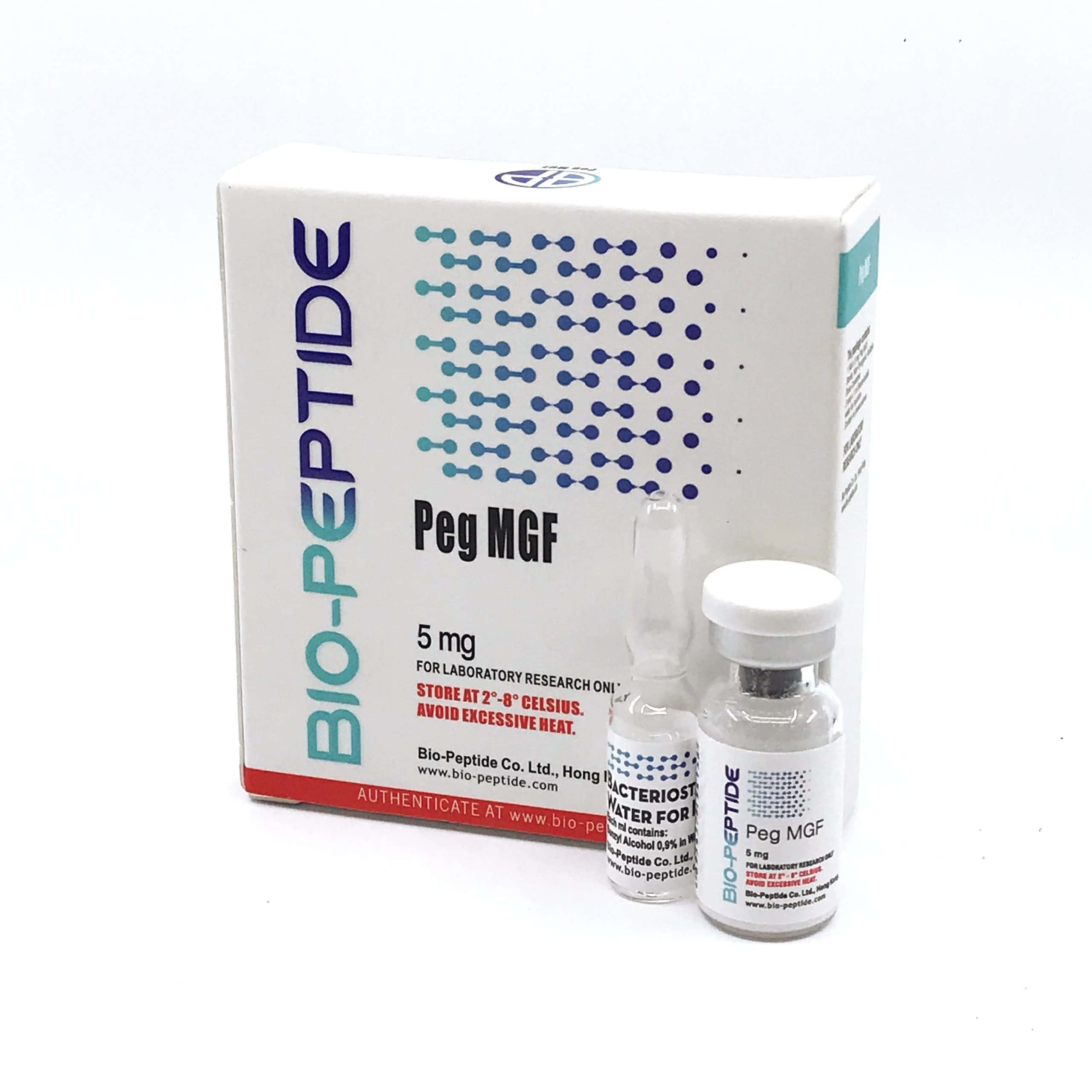
Pegylated Mechano-growth factor (PEG-MGF) originates from an isoform of the IGF-I gene sequence, which undergoes alternative splicing. This process generates distinct peptide variants that may influence cellular responses, particularly under stress or injury. One such variant, often referred to as IGF-IEc, includes additional exons that form an extended region known as the Ec-peptide. Researchers have suggested that this Ec-peptide fragment may contribute to muscle recovery and regenerative processes. Bio-Peptide Peg MGF 5mg/vial.
PEG-MGF represents a modified synthetic fragment derived from this IGF-IEc molecule. The addition of polyethylene glycol (pegylation) appears to enhance stability and reduce rapid clearance, potentially prolonging biological activity. Pegylation may also alter how the peptide interacts with biological systems by influencing immune recognition. Bio-Peptide Peg MGF 5mg/vial.
Alternative Names: Pegylated MGF, Pegylated Mechano Growth Factor
Research indicates that muscle injury or mechanical strain may stimulate a notable increase in mechano-growth factor expression. Controlled studies have documented substantial rises in messenger RNA activity following resistance-based activity, which may suggest a link between physical stress and up-regulated peptide synthesis. Some findings point toward reduced oxidative stress and inflammatory signaling in muscle environments when MGF is expressed, possibly supporting tissue maintenance during repair processes. Bio-Peptide Peg MGF 5mg/vial.
Experimental studies in animal models propose that MGF may reduce cell death in heart muscle exposed to oxygen deprivation. Findings suggest that introducing the peptide within a limited time window after injury could support cardiac cell survival, potentially through recruitment of local stem cells. Evidence also indicates changes in gene expression patterns related to survival, although these interpretations remain under investigation. Bio-Peptide Peg MGF 5mg/vial.
In preclinical bone injury models, MGF exposure has been associated with accelerated healing compared to control groups. Observations suggest that signaling pathways such as MAPK and Erk1/2 may be involved, indicating potential roles in cell proliferation and differentiation. Additional experiments suggest that cartilage degeneration processes may be delayed when MGF is present, with possible influences on protein stress responses within chondrocytes.
Animal studies indicate that MGF may influence neuronal stability under stress or aging. Observations of murine models show potential improvements in motor neuron preservation and cognitive performance when MGF expression is maintained or elevated earlier in life. Evidence also suggests that natural expression of the peptide increases in brain regions affected by injury, hinting at a possible role in adaptive responses.
Research has examined whether MGF exposure may reduce fibrosis and scarring in muscle tissue. Animal experiments have suggested lowered collagen deposition and reduced markers of inflammatory signaling following injury. These findings indicate a possible modulatory role of MGF on the repair environment, though its direct impact on satellite cell activation appears less clear.
Preclinical cell culture research on periodontal tissues has proposed that PEG-MGF may support ligament repair through increased activity of remodeling enzymes. These findings point toward a potential role in maintaining attachment structures, though this area of study remains in its early stages.
Current scientific investigations suggest that PEG-MGF may play a role in several biological processes, particularly those related to muscle adaptation, tissue repair, and cellular stress responses. Evidence from animal and cell-based models points toward potential interactions in muscle, bone, cartilage, cardiac, and neural tissues. While these findings highlight possible directions for future study, the mechanisms and broader implications remain areas of ongoing exploration.






Reviews
There are no reviews yet.