- Your cart is empty
- Continue Shopping


$73.00
C18H31N5O9
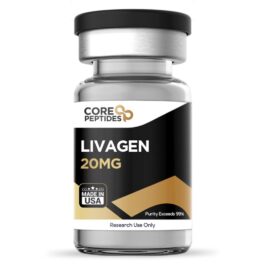
Livagen is a short peptide containing four amino acids: lysine, alanine, aspartic acid, and glutamic acid. Considered to be a bioregulator, this peptide may act on the DNA structure and impact functionality. The primary potential of Livagen is identified in how it acts on chromatin, DNA, and genes.
Scientists have formalized that DNA is a double helix structure surrounded by proteins called “histones.” These histones bind together, forming chromatin, and several chromatins then condense together, forming the chromosomes. These chromosomes appear crucial to forming genetic material specific to each organism.
Livagen has been considered by researchers for its potential to ‘de-condense’ these chromatin materials. As a result, some genes that had become non-functional might become active, possibly improving cell activity and production. Researchers posit that Liva-gen may increase energy levels and skin elasticity and possibly induce improvements in immune system functionality via this mechanism.
Researchers have suggested that the lipid peptide acts on the lymphocytes, possibly reactivating the ribosomes by ‘unpacking’ the chromatin and modifying gene expression. These lymphocytes are white blood cells that are deemed essential in attacking foreign impurities entering the system and enhancing immunity.
In this manner, Liva-gen may exhibit potential to improve the immune system by coordinating cellular responses and controlling inflammatory responses. T. Lezhava et al., who conducted a clinical research study stated that “These results indicate that peptide bioregulators Epitalon, Livagen, and Vilon cause activation (deheterochromatinization) of chromatin in lymphocytes of [aged models].”
Reviews
There are no reviews yet.