- Your cart is empty
- Continue Shopping


$173.00
C3418H5188N928O1062S38
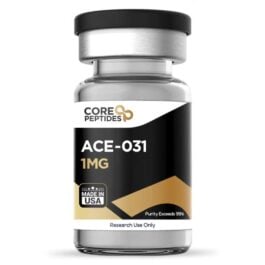
ACE-031 peptide, also known as ActRIIB-IgG1 peptide, appears to be a myostatin inhibitor. In terms of structure, it is a fusion compound consisting of the activin receptor type IIB (ACV2RB) and recombinant immunoglobulin IgG1 FC, which is a form of antibody. Research suggests that this soluble peptide may block the action of circulating myostatin to potentially prevent myostatin from apparently inhibiting the native ACV2RB receptors and thus reducing muscle growth.
Myostatin, also known as growth and differentiation factor 8 (GDF8), apparently may be blocked by certain substances termed inhibitors. These inhibitors may target the actions of naturally occurring myostatin, a possible negative regulator of muscle growth primarily found in skeletal muscle tissues. Interestingly, myostatin seemingly has no impact on cardiac or smooth muscle tissues. The discovery of myostatin dates back to 1997, when it was reportedly identified due to its potential inhibitory action on muscle growth, as observed in comparative murine studies.
Myostatin may inhibit the activation of murine satellite cells, which are partially committed stem cells within muscle tissue. Additionally, overexpression of myostatin has been suggested to lead to muscle mass reduction in experimental models. Myostatin is thought to bind with the ActR2B receptors with a high affinity, potentially initiating a signaling cascade involving Smad2/3, which is crucial for muscle mass regulation. Other ligands, such as other GDFs and activins, might also bind to ActR2B and potentially regulate muscle growth.
These ligands, along with activin receptors, are part of the transforming growth factor-beta (TGF-β) superfamily, which is implicated in controlling tissue growth and differentiation. ACE-031 appears to work by binding with any circulating members from the TGF-β superfamily and, most notably, myostatin. Thus, the ACV2RB receptors in muscle cells remain uninhibited, which is posited to result in the activation of muscle hypertrophy and increase in skeletal muscle tissue size. Besides this, the peptide may have a positive potential for metabolism, fat storage, and bone density.




Reviews
There are no reviews yet.