- Your cart is empty
- Continue Shopping


$78.00
C152H252N44O42
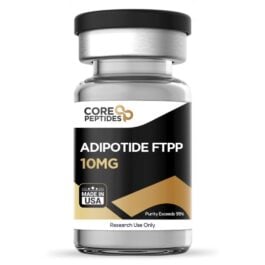
Adipotide Peptide, also known as FTPP (Fat-Targeted Proapoptotic Peptide), fat-targeted proapoptotic peptide, or proapoptotic peptide, has been widely researched and is posited by scientists to be a proapoptotic peptide that may contribute to cell apoptosis. Adipotide may possibly act as a peptide targeting prohibitin, which is why it also bears the name Prohibitin-targeting peptide 1 (Prohibitin-TP01). Current research is still exploring Adipotide’s potential in this area and its potential actions related to its targeting properties. Prohibitins are natural proteins considered by scientists to regulate such functions as cell formation, metabolism, and inflammation. Adipotide (FTPP).
Research teams initially considered Adipotide for its supposed potential to mitigate the action of cancer cells. Still, the peptide indicated it may have research potential for experiments investigating lipolysis and obesity mitigation, leaving the research pioneers “at a loss of words.” It was presumed that Adipotide might prevent blood supply to the cancer cells, resulting in cell death and malignant cell growth inhibition. Adipotide (FTPP).
Upon further research, it was suggested by the scientists that the peptide appeared to exhibit the same mechanism of action but on fat cells instead. This “proof of concept” study was an early-stage experiment suggesting that the peptide may have significant potential. Yet, the compound has to be studied further to understand its full potential and impact on cells.
Researchers isolated a naturally occurring peptide (sequence CKGGRAKDC) via phage display methodology and combined it with a proapoptotic sequence, forming the now-termed Adipotide compound. Adipotide is homologous to the peptide sequence found in the white adipose tissue. Owing to this development and characteristics, researchers suggest that the peptide may possibly target the prohibitin PHB1 found at the surface of the adipose tissue – possibly attaching and thereby damaging them, potentially causing a blood supply disruption to the adipocytes (fat cells).
Prohibitins are considered by scientists to act as a vascular marker of the fatty tissues, and Adipotide may possibly be able to identify these markers and consequently conduct apoptosis on these cells. Further, researchers speculate that Adipotide may interact not only with prohibitin but also another receptor called annexin A2 (ANX2) and thus potentially disrupt their role in supporting blood and fat supply to fat cells in white adipose tissue. Adipotide (FTPP).
Studies suggest that prohibitin and ANX2, when interacting in a complex with a fatty acid transporter called CD36, potentially facilitate the uptake of fatty acids by the endothelium and their subsequent transport into adipocytes. One study suggested that there was a purported white adipose tissue hypotrophy in murine models lacking ANX2, despite apparently normal white adipose tissue vascularization, adipogenesis, and glucose metabolism. Adipotide (FTPP).
This condition was potentially attributed to reduced fatty acid uptake by white adipose tissue endothelium and adipocytes. It was suggested that the efficiency of fatty acid transport relies on the interaction of ANX2 and prohibitin. This interaction was posited to be essential for mediating fatty acid transport from the endothelium into adipocytes. Additionally, it was commented that ANX2 and prohibitin form a complex with CD36, and this interaction is crucial for fatty acid transport. Adipotide (FTPP).
Importantly, the colocalization of prohibitin and CD36 on the adipocyte surface was induced by extracellular fatty acids, suggesting a dynamic regulation of this protein complex in response to fatty acid levels. The study posited that the biochemical interaction between ANX2 and prohibitin potentially regulates CD36-mediated fatty acid transport in white adipose tissue, unveiling a potential pathway that compounds like Adipotide might target. Consequently, Adipotide is posited to potentially burn the fat stored in these fat cells as fuel, according to researchers’ speculations.
Based on early preclinical studies on monkeys, it was also suggested that following Adipotide presentation, the monkeys exhibited apparently reduced insulin resistance.
Reviews
There are no reviews yet.