- Your cart is empty
- Continue Shopping


$65.00
| CAS Number | 123618-03-1 |
| Other Names | Insulin-like growth factor I (57-70), Igf-1 (57-70), Somatomedin C (57-70), DTXSID20154054 |
| IUPAC Name | (4S)-5-[[(2S)-1-[[(2S)-1-[[(2S)-6-amino-1-[[(2S)-1-[(2S)-2-[[(2S)-1-[[(2S)-6-amino-1-[(2S)-2-[[(2S)-1-[[(2S)-6-amino-1-[[(2S)-1-[[(1S)-1-carboxyethyl]amino]-3-hydroxy-1-oxopropan-2-yl]amino]-1-oxohexan-2-yl]amino]-1-oxopropan-2-yl]carbamoyl]pyrrolidin-1-yl]-1-oxohexan-2-yl]amino]-4-methyl-1-oxopentan-2-yl]carbamoyl]pyrrolidin-1-yl]-1-oxopropan-2-yl]amino]-1-oxohexan-2-yl]amino]-3-(4-hydroxyphenyl)-1-oxopropan-2-yl]amino]-4-methylsulfanyl-1-oxobutan-2-yl]amino]-4-[[(2S)-2-amino-4-methylpentanoyl]amino]-5-oxopentanoic acid |
| Molecular Formula | C₃₁₉H₅₀₁N₉₁O₉₆S₇ |
| Molecular Weight | 7371.48 |
| Purity | ≥99% Pure (LC-MS) |
| Powder Availability | 1 milligram vial (lyophilized/freeze-dried) |
| Storage Condition | Store cold, keep refrigerated. Do NOT freeze. |
| Terms | All products are for laboratory developmental research USE ONLY. Products are not for human consumption. |
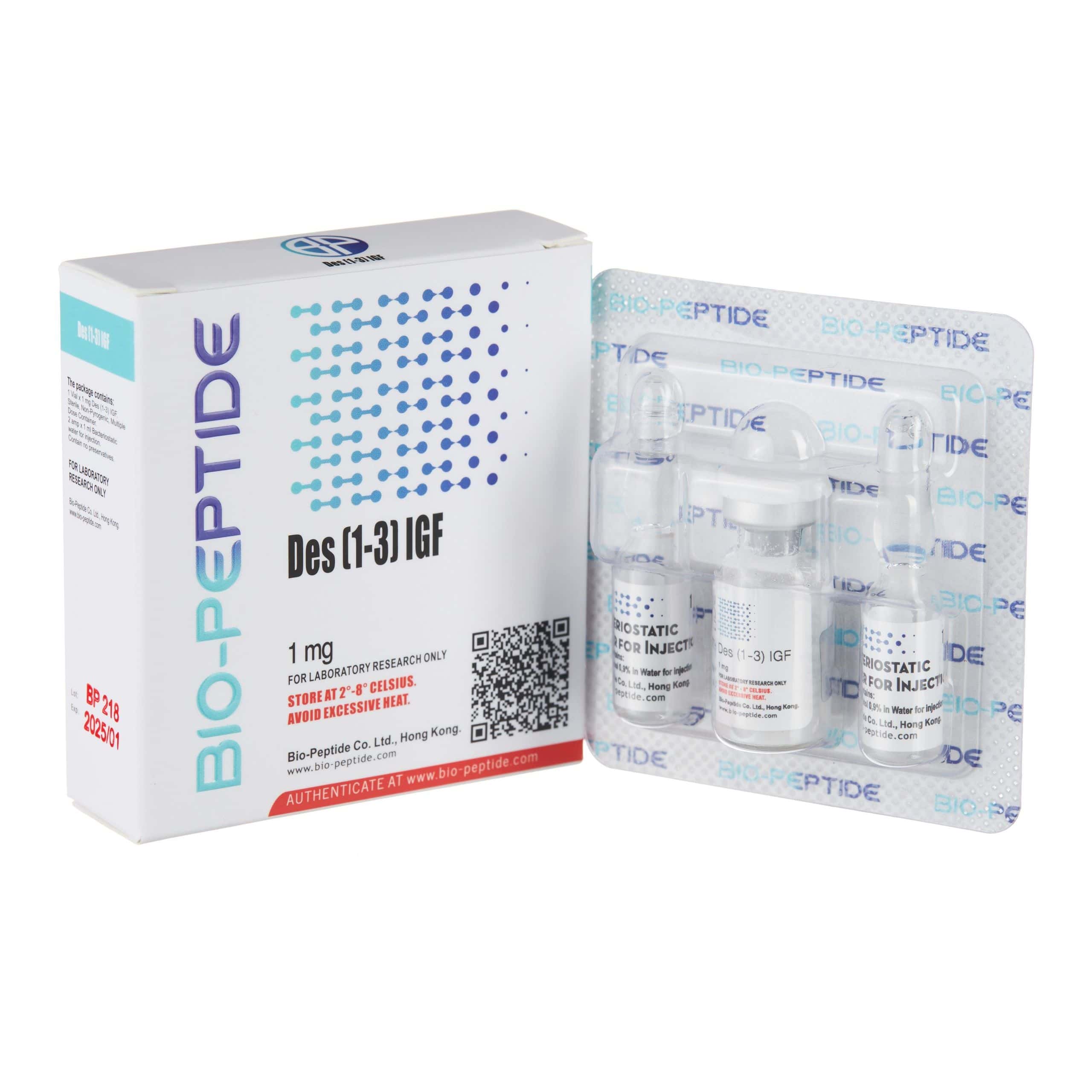
IGF-1 DES is a truncated variant of insulin-like growth factor-1 (IGF-1). IGF-1 is typically composed of 70 amino acids but IGF-1 DES is a shortened analogue with only 67 amino acids. The first three amino acids that are emitted are Gly-Pro-Glu which are removed through the N-terminus. By shortening the peptide chain IGF-1 becomes 10 times more potent in terms of increasing hypertrophy as well as reducing the binding of IGF-1 binding proteins due to the absence of glutamate. Des (1-3) 1GF 1mg/vial.
Increasing the potency is important when it comes to the efficacy of the peptide and maximizing muscle growth. The improved potency comes from the ability of IGF-1 DES to efficiently bind to lactic acid receptors. IGF-1 DES is capable of binding to certain cellular receptors that have been mutated due to the presence of lactic acid, allowing for increased signaling for tissue growth. However, this truncated form of the peptide has a short half-life of only about 20-30 minutes [1]. Des (1-3) 1GF 1mg/vial.
Main Research Findings
1) Results of this study reported that IGF-1 DES led to excitatory transmission in the CA1 region of the rat hippocampus and enhancement of fEPSP slopes in a dose-dependent manner. Des (1-3) 1GF 1mg/vial.
2) The research team of Elis et. Al found in KID and KIR mice models, IGF-1 is crucial for the development of normal body, organ, and bone size. Des (1-3) 1GF 1mg/vial.
3) Results of the study found that subcutaneous injection of IGF-1 DES at the onset of diabetes can act as a protective measure against predegenerative biochemical abnormalities. Des (1-3) 1GF 1mg/vial.
Selected Data
1) The research team utilized male Sprauge-Dawley rats as test subjects for this experiment. Once the subjects reached 20-40 days old they were anesthetized with halothane in order for researchers to obtain slices of certain brain regions. Coronal hippocampal slices were prepared with a vibrating tissue slicer and maintained at room temperature in a solution of oxygenated artificial cerebrospinal fluid (ACSF). The ACSF contained 124mM NaCl, 3.3 mM KCl, 2.4 mM MgCl2, 2.5 mM CaCl2, 1.2 mM KH2PO4, 10 mM D-glucose, and 25.9 mM NaHCO3. The slices were saturated with the ACSF twice per minute during the observation period [2].
Researchers used NMDA receptor antagonists (APV), GABA receptor antagonists (BIC), and AMPA/KA receptor antagonists (DNQX) in order to pharmacologically isolate and observe evoked currents. IGF-1 DES was prepared as a stock solution in 0.1 N acetic acid.
Various compounds were used in order to examine the signaling components of IGF-1, including, tyrosine kinase inhibitors, PI3K inhibitors and LY 294002 inhibitors. Like IGF-1 DES these inhibitors were made into a stock solution, however, instead of acetic acid dimethyl sulfoxide (DMSO) was used. All drugs were administered via ACSF [2].
In order to collect data electrodes were prepared and filled with a recording solution containing 120 mM K-gluconate, 10 mM KCl2, 5 N-(2,6-dimethyl-phenylcarbamoylmethyl)-triethylammonium bromide, 1mM EGTA, 0.1 mM CaCl2, 2 Mg-ATP, 0.2 tris-GTP, and 10 mM free acid (HEPES).
Neuron voltages were clamped at -70 mV in order to record AMPA-mediated excitatory postsynaptic currents (EPSCs) while in the presence of antagonists, APV and BIC. Neuron voltages were clamped and -30 mV in order to record NMDA-mediated EPSCs while in the presence of DNQX and BIC. The synaptic currents were sent every 20 seconds by way of a 0.2 ms long electrical stimulation of the adjacent tissue to the electrode [2].
Field excitatory postsynaptic potentials (fEPSPs) were obtained under the same conditions and using the same recording equipment as the patch-clamp recordings. The only change made was the adjustment of the recording electrodes which were now placed in the apical dendritic field.
The IGF-1 DES-induced concentration-response curves of EPSCs and fEPSPs were analyzed by one-way ANOVA and Newman-Keuls test for comparisons. Dunnett’s post hoc test and one-way ANOVA tests were used to compare inhibitory effects on IGF-1 DES-mediated changes in fEPSP slopes [2].
2) The study conducted by Elis et. Al aimed to find how bioavailable derivatives of IGF-1 affects somatic and skeletal growth as well as body composition and tissue integrity. The research team created two mutated mouse models with knock-in RE-IGF1 and IGF-1 DES. The first mutant substituted an E amino acid for an R at position three and was named knock-in R (KIR).
While the second mutant is missing the first three amino acids of IGF-1 (IGF-1 DES) and was named knock-in D (KID). The two mutated mouse models represent an unbound form of IGF-1 with impaired post-translational control and increased bioavailability; they are then used to characterize the effects of KIR and KID in this scenario [3].
Serum levels of IGF-1 in KID and KIR mice were observed by using a radioimmunoassay (RIA) kit. The same RIA kit was used to measure recombinant RE-IGF1 and IGF-1 DES. The bioactivity of free IGF1 in serum was observed using a cell-based IGF-1 kinase receptor activation (KIRA) bioassay. This is used to determine the ability of the serum to stimulate IGF1R activity in vitro [3]. Des (1-3) 1GF 1mg/vial.
3) 12-week-old male Sprague-Dawley rats were assigned to different treatment groups and used for animal experimentation in accordance with NIH guidelines. The animals were split into two experimental groups and a control group, each group had 5 rats. All solutions were administered to the rats through Acrodisk filters. The experimental groups were intraperitoneally administered a 50 mg/kg dose of STZ in order to induce diabetes. Des (1-3) 1GF 1mg/vial.
The control group was labeled non-diabetic (ND) while the first experimental group was labeled at STZ-veh indicating the animal was diabetic and received vehicle treatments. The second experimental group was labeled STZ-des, the diabetic rats received an active dose of IGF-1 DES. Each treatment was administered through a subcutaneous osmotic minipump over the course of two weeks [4]. Des (1-3) 1GF 1mg/vial.
After two weeks of treatment the rats were euthanized and the eyes were preserved with 4% paraformaldehyde in phosphate buffered saline (PBS). The preserved eyes were set in paraffin and cut into slices measuring approximately 4 micrometers in length. Additionally, tail blood was collected in order to measure glucose assay 24 hours after STZ or vehicle treatment and again at 2 weeks after treatment. Des (1-3) 1GF 1mg/vial.
The retinal tissue slices were rehydrated through the use of xylene and various graded alcohol concentrations. The samples were then properly prepared by rinsing in PBS and incubation with the primary antibodies. The slices were stained in order to identify the number of immunoreactive cells in the ganglion cell layer (GCL) and the inner nuclear layer (INL) throughout three randomly chosen segments [4]. Des (1-3) 1GF 1mg/vial.
Conclusion
LAB USE ONLY
This information is for educational purposes only and does not constitute medical advice. THE PRODUCTS DESCRIBED HEREIN ARE FOR RESEARCH USE ONLY. All clinical research must be conducted with oversight from the appropriate Institutional Review Board (IRB). All preclinical research must be conducted with oversight from the appropriate Institutional Animal Care and Use Committee (IACUC) following the guidelines of the Animal Welfare Act (AWA). Des (1-3) 1GF 1mg/vial.
Reviews
There are no reviews yet.