- Your cart is empty
- Continue Shopping


$50.00
C124H204N42O41S1
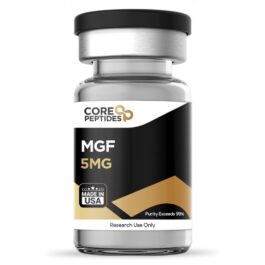
MGF stands for Mechano Growth Factor, an endogenous, naturally occurring peptide that belongs to the class of IGF-1 (insulin-like growth factor) family. What differentiates MG-F from systemic IGF-1 is that it contains 49 base pairs at exon 5 in its structural composition, which may possibly introduce a frameshift to exert unique characteristics. Researchers consider MGF to be an isoform of IGF-1, also known as IGF-1Ec (otherwise referred to as full-length MG-F).
As IGF-1 undergoes alternative splicing and transcription, it appears to produce three isoforms. IGF-1 undergoes splicing under stress conditions, such as during resistance activities within muscle groups. As a result of this splicing and due to the unique 49 base pair insert added to the peptide, it may produce a mature isoform of IGF-1, namely, naturally occurring MG-F.
During IGF-1 research studies, scientists first posited the phenomenon of IGF-1 splicing and isoform production. The only factor identified by the researchers that distinguished the three isoforms appears to be the amino acid sequence attached to the COOH terminal. It was only in the late 1990s and early 2000s that the uniqueness of IGF-1Ec was suggested when it was theorized that its levels increased upon muscle injury.
There is a synthetic version of the MG-F peptide composed of 24 amino acids attached to the C-terminal of the isolated MG-F domain, called MG-F-Ct24E peptide, or E-domain of IGF-1Ec. During the studies conducted in the early 2000s, it was suggested that the MGF-Ct24E peptide may exhibit potential to induce muscle precursor cell proliferation. Muscle precursor cells are ‘satellite’ cells in myofiber, which increase to form new muscles.
MGF is posited to increase in a growth hormone-dependent fashion, akin to IGF-1, which is also considered to potentially represent the main anabolic mediator of growth hormone. Studies suggest that growth hormones may also impact MGF expression by approximately 80%, relative to the baseline. In stark contrast, resistance activity in muscle tissue alone appears to elicit a response in MGF mRNA, with an increase of 163% from baseline.
This immediate response may suggest a more direct or sensitive reaction of MGF to mechanical stimuli, yet the extent and nature of this sensitivity remain speculative. An apparent elevation of growth hormone that occurs in addition to resistance training might further complicate this response, as supported by a reported 456% increase in MG-F mRNA.
Research studies are still underway to determine the mechanism of action of both the naturally occurring and synthetically developed MGF peptide. Hypotheses under investigation include the peptide’s potential impact on damaged muscle cells, tissue repair and recovery, possible neuroprotective and cardioprotective characteristics, and potential impact on muscle cell apoptosis.





Reviews
There are no reviews yet.